




Eye For Film >> Movies >> La Belle Et La Bête (1946) Film Review


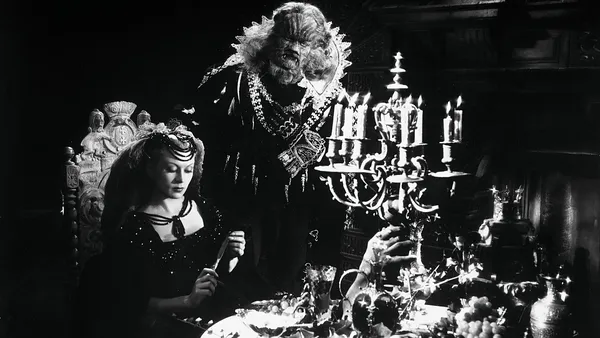

Returning home through the woods, Beauty's father leaves the path in search of a rose to give to his daughter and unwittingly enters the Beast's magical chateau. The next morning, he meets the fearsome Beast, who will only let him leave on condition that he sends one of his daughters to the chateau.
The two ugly sisters refuse the proposition, whereas the virtuous, obedient Beauty consents.

The Beast tries to hide his ugliness from her, but nevertheless she is able to discern his underlying goodness beneath the fearsome demeanour.
After a time, he lets her leave his magic kingdom, hoping that she will decide to return forever. She does but, unfortunately, so too do Beauty's betrothed and another ne'er-do-well, intent on stealing the Beast's treasure.
Jean Cocteau's interpretation of the myth, drawing its inspiration from Mme Leprince de Beaumont's mid-18th century version of the tale, presents viewers with an awkward combination of adult sophistication and childish naivete.
References to Vermeer and De Hooch, or to Orpheus and Euridice - a constant in the poet/artist/what-have-you's film-making, from his first Blood Of A Poet through his last The Testament Of Orpheus - are likely to escape the Disney constituency. But the fact that it's in black-and-white and French obviously won't.
Yet, consciously primitive Melies-like effects, or pantomiming ugly sisters, require sophisticated adult viewers to play phenomenological tricks on themselves.
Those willing to accept Cocteau's contract - he pleads our indulgence and suspension of disbelief in a written preamble - will find the film enchanting. But even hard-headed cynics, who cannot (dis)believe, may find Henri Alekan's beautiful cinematography and the sumptuous - though low-budget - production design adequate rewards in themselves.
Reviewed on: 20 Jan 2002


Director: Jean Cocteau
Writer: Jean Cocteau, based on the story by Mme Leprince de Beaumont
Starring: Jean Marais, Josette Day, Marcel Andre, Mila Parely, Nane Germon, Michel Auclair, Raoul Marco
Year: 1946
Runtime: 90 minutes
BBFC: 
Country: France
Search database: