





Eye For Film >> Movies >> Million Dollar Baby (2004) Film Review


It's not often a film from a major studio dares to deny its characters redemption or hope or even spiritual sustenance. And it's probably fair to say that Million Dollar Baby, in its present form, might never have seen the inside of a cinema without the considerable clout of director/star Clint Eastwood. But while insider power has greased the path of many a substandard movie, Eastwood's Baby is a tour de force of stark, pared-to-the-bone craftsmanship.
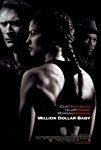
Based on an anthology of short stories by the late fight manager and "cut man" Jerry Boyd (writing as FX Toole), Million Dollar Baby is a boxing movie the way Bull Durham is a baseball movie, which is to say, only incidentally. Eastwood plays Frankie Dunn, a professional trainer and the owner of a ramshackle gym in downtown LA. Frankie also manages young boxing hopefuls, only to lose them to more aggressive managers when his over-protectiveness keeps them from the title fights their careers demand. Best friend and gym manager Eddie "Scrap-Iron" Dupris (Morgan Freeman) no longer tries to intervene; he knows Frankie's aversion to risk is an organic thing, an immune reaction to his own tragedies.

It's to the film's credit that these tragedies are alluded to rather than explained, little snippets of back story dropped into the narrative exactly where they're most needed. We learn that Frankie has a daughter he writes to every week and for 23 years the letters have found their way back to him unopened. We know he feels responsible for the fight that led to Scrap's partial loss of sight. And we know he goes to Mass, frequently and hopelessly, lingering afterwards for an angry, ongoing dialogue with his patient priest (Brian O'Byrne). Whatever Frankie is praying for, his God isn't answering.
When a white trash waitress named Maggie Fitzgerald (Hilary Swank) starts hanging around the gym pestering Frankie to train her, he brushes her off. "I don't train girls," he snaps, pointing out that at 31, she's too old to train anyway. Then he relents, impressed by her desperation and refusal to back down. And as the training sequences are replaced by girlfights and injuries and lessons learned, you may think you know where this film is going. Believe me, you don't.
Economical to a fault, Million Dollar Baby is a movie where formulas don't apply. The expected rhythms of the underdog film, the familiar emotional cues of melodrama are present, but only up to a point. The screenplay, by the talented Paul Haggis, whose 1996 TV drama EZ Streets remains the most interesting cancelled show of the last decade, blithely cuts corners and encourages the audience to fill in the blanks. This won't appeal to everyone; Hollywood has trained us to expect every stop on the narrative highway clearly signposted and it's easy to forget that what we get out of a movie largely depends on what we bring to it.
Million Dollar Baby is a love story in the purest sense, a connection of outcasts who find in each other what they can't find elsewhere. Gorgeously photographed by Mystic River's Tom Stern in thick blocks of shadow and light, the movie has the look of a Forties noir and the well-thumbed sentiment of an old man's life. This seems fitting: at 75, Eastwood's impressive catalogue on both sides of the camera has rendered him iconic. With nothing to prove and no one to please but himself, he plays Frankie with mouth turned down and pants hiked up, comfortable in the skin of an aging dreamer, brutalized by guilt and regret. Frankie knows that some burdens just have to be borne and there's not a damn thing we can do about it.
Reviewed on: 28 Feb 2005



Read more Million Dollar Baby reviews:
| Scott Macdonald |  |
| Angus Wolfe Murray |  |
| Stephen Carty |  |
Director: Clint Eastwood
Writer: Paul Haggis, stories by FX Toole
Starring: Clint Eastwood, Hilary Swank, Morgan Freeman, Jay Baruchel, Mike Colter, Lucia Rijker, Brian O'Byrne, Anthony Mackie, Margo Martindale, Riki Lindhome, Michael Pena, Benito Martinez, Bruce MacVittie
Year: 2004
Runtime: 137 minutes
BBFC: 
Country: US
Festivals:
Search database: