





Eye For Film >> Movies >> Lemony Snicket's A Series Of Unfortunate Events (2004) Film Review


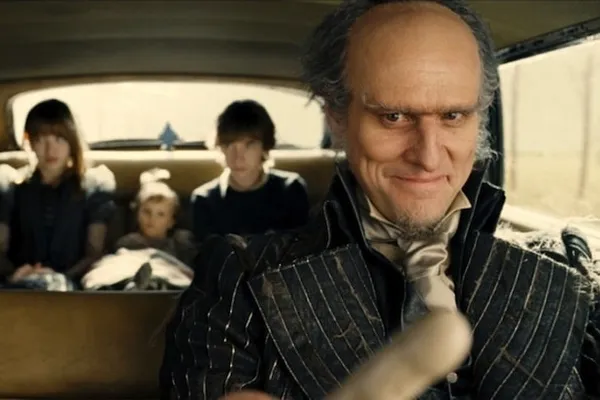

Jim Carrey makes a compelling villain, so much so that when he's not on screen, you want him back. This upsets the balance, because the central characters are the Baudelaire orphans, who are left to fend for themselves after their parents are killed in a mysterious fire.
The style of the film is very Tim Burton, with its Gothic humour and distorted architecture. Count Olaf, whose sole purpose appears to be the elimination of the children for the sake of their inheritance, is a scary guy. Being an ACTor, he prances about with his petrified hair sticking out the back and eagle nose protruding like a scythe and elastic limbs contorted into Cat In The Hat.

Carrey is in his element and he takes full advantage, dominating the film with a performance that is outrageous and riveting, like watching comic genius unfettered by the constraints of theatrical convention. As a result, Billy Connolly, as eccentric Uncle Monty, and Meryl Streep, as nervous Aunt Josephine, are caught in his slipstream and swept away. Only the children, particularly Emily Browning, as 14-year-old Violet, can hold a line to Carrey in full flow.
This is a story of survival, a journey through the wilder reaches of the imagination, where Olaf's evil schemes and elaborate disguises conspire to capture the orphans and deceive their guardians, which can feel repetitive and episodic at times.
Violet, Klaus (Liam Aiken) and little Sunny (Kara and Shelby Hoffman), whose baby mumbles are translated into subtitles - probably the best joke - have to think laterally and it is Violet's catch phrase ("There's always something") that enables them to outwit their devious nemesis and stay three steps ahead.
The plot dips and dives into areas of confusion, illustrated with inventive affects. Olaf has a mission, but the children don't, which leaves them at the mercy of unfortunate events. Although visually arresting, with clever touches, such as the involvement of the writer (Jude Law), who offers his opinion on story development, the film's tone may be too dark for a young audience. Carrey showed in The Grinch and The Cable Guy that comedy does not need to feel safe. It can disturb.
It does.
Reviewed on: 17 Dec 2004


Director: Brad Silberling
Writer: Robert Gordon, based on the books by Daniel Handler
Starring: Jim Carrey, Meryl Streep, Jude Law, Billy Connolly, Emily Browning, Liam Aiken, Kara Hoffman, Shelby Hoffman, Timothy Spall, Luis Guzman, Jennifer Coolidge, Jane Adams, Craig Ferguson, Jamie Harris, Cedric The Entertainer, Catherine O'Hara, Deborah Theak
Year: 2004
Runtime: 108 minutes
BBFC: 
Country: US
Festivals:
Search database: